

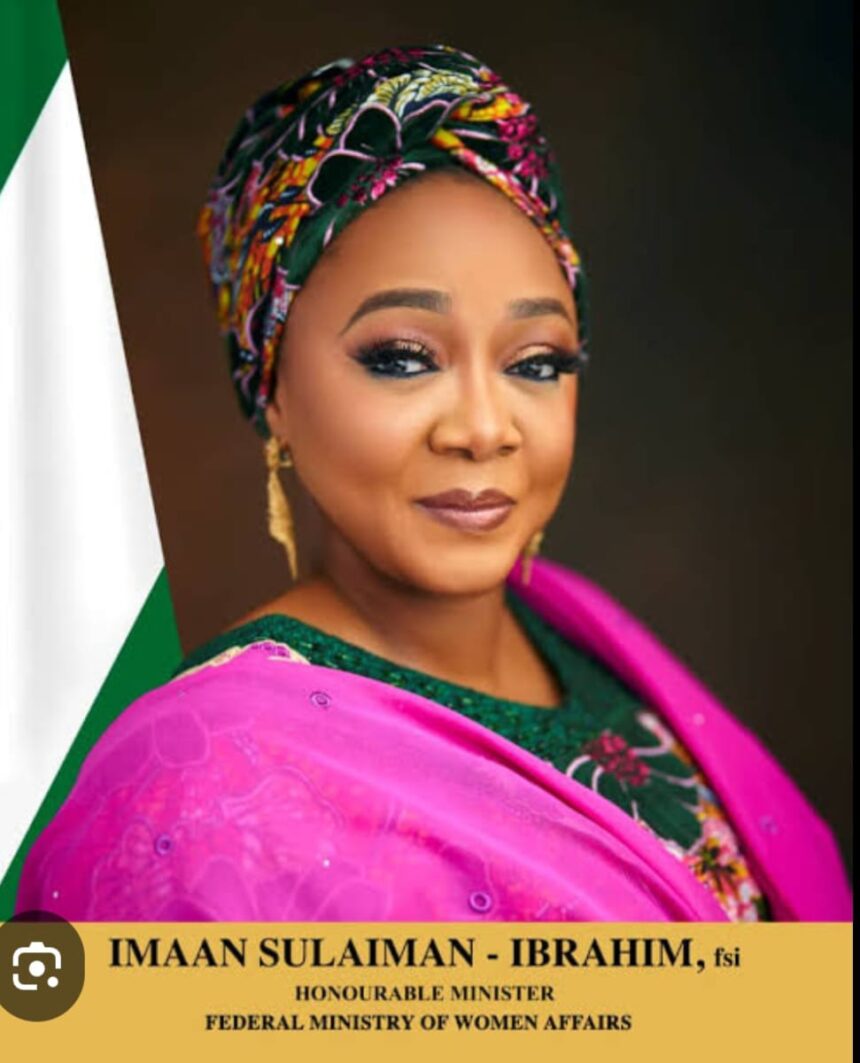
Long before she assumed duty at the Federal Ministry of Women Affairs, Hon. Imaan Suleiman-Ibrahim understood the meaning of vulnerability. As the Federal Commissioner for Refugees, she walked the difficult path with those displaced by conflict.
That grounding in empathy, combined with her tenure as Minister of State for Police Affairs, has shaped a public servant who leads with both compassion and a firm hand. Now, as a key architect of President Bola Ahmed Tinubu’s Renewed Hope agenda,
she is channeling those years of experience into a mission to uplift Nigerian women, proving that effective governance is about building bridges between policy and the people.Her trajectory from the National Commission for Refugees, to Minister of State for Police Affairs, and now to the helm of the Women Affairs ministry, has been a study in focused leadership.
Today, she is not just managing a ministry; she is repositioning the Nigerian woman as a critical engine for the actualization of the Renewed Hope agenda.
When President Tinubu appointed Suleiman-Ibrahim to this role, many expected a steady hand. What they have gotten, however, is a whirlwind of activity, strategic foresight, and a refreshingly inclusive approach to governance.
Her tenure is rapidly defining what the President’s declaration of 2025 as the “Year of the Woman” and the broader focus on families truly means in practical terms.
During a recent briefing at the State House, the President reaffirmed that women are not merely beneficiaries of government programmes but are “primary drivers of national transformation and key agents in the realisation of Nigeria’s economic ambition.”
That is not just political rhetoric; under Hajiya Imaan, it is becoming an operational blueprint.
Before we look at her current achievements, it is important to remember that this is a woman who has spent years dealing with the most vulnerable segments of our society.
That experience instilled in her a level of empathy that is rare in the corridors of power. It also taught her that governance is not just about policy documents; it is about human impact.
This is evident in the flagship projects she has been driving. Not long ago, the minister was in Abia State to commission two landmark initiatives that cut to the heart of what economic inclusion should look like.
She inaugurated the Osusu Abaala Women Palm-Oil Collective in Isialangwa North Local Government Area. This is not one of those hand-out programmes that fizzle out after the cameras leave.
This is a practical demonstration of organised women transitioning from fragmented informal activity to coordinated, market-oriented production.
This is the kind of “bottom-up” approach President Tinubu has consistently preached about—where local enterprise is strengthened to boost household incomes and stabilise local economies.
Furthermore, she launched the state’s Sexual Assault Referral Centre in Abia. This is a critical component of the national strategy to combat Gender-Based Violence.
As of last year, Nigeria had fifty of such centres across twenty-four states, assisting tens of thousands of survivors.
The Minister has made it clear that under the Renewed Hope Social Development Agenda, protection services are now a core pillar of national stability. “Silence, stigma, and impunity must no longer define the experience of survivors,” she declared recently.
These are strong words backed by action, including the recent push for an emergency response fund to tackle the severe underfunding that has left safe spaces and survivor support centres struggling.Despite her national assignment, Hajiya Imaan has not forgotten her roots.
She remains a proud daughter of Nasarawa State, and her connection to the grassroots there offers a clear window into her leadership style.
It is one thing to sit in Abuja and issue directives; it is another to go to the field and mobilise. Just recently, in Lafia, she was spotted monitoring the party’s e-registration exercise.
But she wasn’t there just to supervise; she was there to mobilise women. She urged them to stop complaining about being sidelined in politics and to take advantage of the registration to assert their place.
“This is the time for women to come into mainstream party politics,” she told them.
She didn’t stop at giving a speech. She donated laptop computers and cash incentives to support the registration exercise across the state’s local government areas.
That is the kind of practical support that endears leaders to the people. Her homecoming also took the shape of high-level engagement with the youth. Recently, a delegation of Nasarawa youth leaders paid her a courtesy visit in Abuja.
The discussion centered on skill development, entrepreneurship, and peace-building initiatives in Nasarawa communities.
For a minister who manages a national portfolio to dedicate time to the specific challenges of her home state’s youth shows a leader who understands that charity begins at home, but should not end there.
She is building a pipeline of empowered youths who will, in turn, champion the cause of national development.However, it has not been all smooth sailing.
To add value to the administration, a minister must show they can handle the inevitable turbulence of public service. The headquarters of the Ministry of Women Affairs, like many government establishments, is a complex environment with diverse interests and strong personalities.
Managing this space requires a delicate balance of authority and inclusivity. Hajiya Imaan has, by all accounts, navigated these waters with the dexterity of a seasoned administrator. While specific internal crises are often kept out of the public eye to maintain the dignity of the office, the Minister’s ability to foster collaboration is evident in her inter-agency relations.
A perfect example is the recent thaw and strategic partnership with the National Population Commission. For years, the lack of reliable data has hampered gender-focused policies.
The Minister recently received the NPC delegation led by its Chairman, and the outcome was a pledge for closer collaboration on birth registration and the building of a reliable gender-focused national database.
This might seem like a routine meeting, but in the machinery of government, it is a significant win. It means that the Ministry is breaking down silos.
By ensuring that children are properly registered and that gender data is accurately captured, the ministry is laying the groundwork for evidence-based planning.
This inclusivity—reaching out to other agencies, welcoming their input, and forging a common path—shows a leader secure enough to know she cannot do it alone.
It is this ability to build bridges that has kept the ministry focused on its mandate despite the usual bureaucratic bottlenecks.
It would be disingenuous to paint a picture of progress without mentioning the stark challenges of funding. The Minister has been very open about this.
When she appeared before the Senate Committee on Women Affairs recently to defend the ministry’s budget proposal, she revealed the frustrating reality of governance: poor fund releases.
Out of the sum appropriated for capital expenditure in the previous year, only a paltry amount was released late in the year—too late to be utilised. Despite this, her request for an upward review was not a cry of despair but a strategic move.
She is fighting to unlock donor commitments, which require counterpart funding. This demonstrates a minister who is thinking outside the immediate constraints of the treasury.
She is leveraging international partnerships to fill the gaps, all while being frank with the National Assembly about the need for better fiscal discipline from the executive.
The fact that the conversation is happening openly, without rancor, suggests a mature political environment where the Ministry and the National Assembly are working to find solutions rather than trading blame.
Hon. Imaan Suleiman-Ibrahim represents a new breed of Nigerian politician. She is young, experienced, and incredibly focused.
Her work at the Ministry of Women Affairs is a direct extension of the President’s Renewed Hope Agenda, particularly the focus on social development and the family.
She is demonstrating that leadership is not just about holding an office, but about redefining its possibilities.
From empowering palm-oil processors in Abia, to digitally registering women in Nasarawa, to fighting for every kobo in the budget to combat GBV, she is touching lives in a manner that is both profound and practical.
She has managed the internal dynamics of her ministry with the poise of a crisis-tested administrator, ensuring that despite the challenges of funding and logistics, the ship stays the course.
As President Tinubu pushes for a stronger economy, he needs ministers who can deliver at the micro-level what is envisioned at the macro-level. Hajiya Imaan Suleiman-Ibrahim is doing exactly that.
She is proof that when you put a committed Nigerian woman in charge, she doesn’t just occupy the space—she transforms it. And for the women and youths of Nasarawa State, and indeed Nigeria, that transformation is coming not a moment too soon.
Abare, a Muck Rack journalist, writes from Lafia, Nasarawa State