

By Abdullahi Yusuf with reports from Mohammed Kabir Yau, Abbas Ibrahim, Salisu Ibrahim Fagge, Mustapha Muhammad and Kabiru Fulatan
The month of February 2026 was a period that cannot be easily forgotten by the people of Kano, particularly traders doing business at the famous Singer Market.
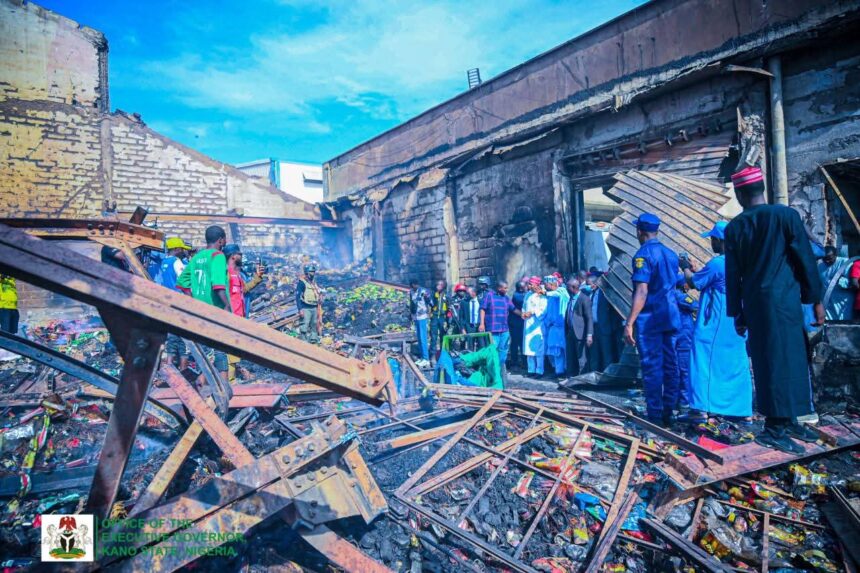
On two occasions, during that memorable period, the market was engulfed by fire outbreaks, resulting in the huge loss of essential commodities worth billions of Naira.
The two fire disasters struck the market in short intervals, consuming property worth billions of Naira, widely believed to be the worst inferno ever witnessed to have bedeviled the market.
Investigations by our Team of reporters found that the valuables lost to the two unfortunate fire incidents included foodstuff, toiletries, textile materials and assorted vehicles.
Chairman of the Singer Market Association, Barrister Junaidu Muhammad Zakari, told our reporters that the first fire started at a large warehouse located within the MAZAF complex in the heart of the market, destroying two of the biggest warehouses and property worth billions of Naira.
It was also gathered that due to the intensity of the blaze, a nearby two-storey building was also engulfed and eventually collapsed, burning to ashes everything in the structure.
Barrister Zakari said the affected buildings in the two separate fire incidents, were heavily stocked with various goods, including cartons of biscuits, milk products, detergents, and smoked fish, causing collosal losses to the helpless traders.
Firefighting teams from the Kano State Fire Service, the Federal Fire Service, as well as the fire unit of the Mallam Aminu Kano International Airport, responded promptly and made significant efforts in containing the blazes.
As at the time of filing this report, neither the affected traders nor the sympthasizers could tell the real causes of the two fire incidents, except some suggestions that they were possibly sparked by Solar power installations, congestions and reactions of certain chemicals stocked within the endangered market.
But the Renewable Energy Association of Nigeria (REAN) quickly cautioned against drawing premature conclusions on the cause of the inferno pointing out that a detailed industry-led investigation into the incident to ascertain the actual cause of the infernos.
The association said it was aware of reports linking the inferno to a possible explosion involving a solar battery system, but stressed that the cause of the incident had not been officially confirmed by the relevant authorities.
In a statement signed by its Communications Director, Oisereime Lloyd-Dietake, REAN expressed sympathy to the victims and reiterated that safety remained a core priority in the deployment of renewable energy systems across the country.
“The Renewable Energy Association of Nigeria is aware of reports concerning a recent fire incident that occurred at Singer Market, Kano, which has been speculated to have been linked to an explosion from a solar battery system.
We are deeply concerned about the incident and extend our sincere thoughts to the individuals, businesses, and families affected. Safety remains paramount in the deployment and operation of renewable energy systems across Nigeria,” Lloyd-Dietake said.
Similarly, while the total value of property lost during the disaster was still being determined as at the time of publishing this report, the Kano Chamber of Commerce, Industry, Mines and Agriculture (KACCIMA) through its President, Amb. Hamza Darma, quoted N15 billion as the estimated loss.
The Chairman of the Disbursement Committee on the market’s fire disaster, Alhaji Umar Faruk Ibrahim, however put the figure above N20 billion.
“The extent of the destruction there, you could see, just by mere mental assessment, is far beyond N20 billion, “Faruk said.
He described the loss of valuables during the inferno as “Monumental,” and appealed to Nigerians to assist the traders in cushioning the effects of the disaster.
Faruk, who is also the Secretary to the State Government, disclosed that the Federal Government had donated N5 billion, while the APC Progressives Governors Forum had also donated N5 billion in aid of the victims with additional donations running into millions of Naira from symphasizers, he added.
“We are appealing to good Nigerians to come to the aid of these traders. We assure them that whatever Kobo they donate will get to the victims.
“And we assure the good people of Kano State that we will render account in details of every Kobo received in aid of the victims of the unfortunate fire incidents.
“This committee is made up of respectful people who have advanced in age. People who value their integrity so much.
None of the Committee members would either compromise or circumvent the mandate given to them by the Government,” the Chairman assured.
He warned that the committee would not condone dishonesty on the part of the affected traders during the disbursement of donations received in their aide.
“Anybody who thinks he can use any trick to falsify a claim, the least he would suffer is to forego any support that would go to him, and the worst would be a prison term,” he warned.
Our checks further revealed another issue of grave concern, which has to do with insurance cover for businesses being run at the market.
It was found that most ventures have not been insured, as confirmed by the Chairman of the market’s association, Barrister Zakari.
He blamed the situation on the stringent conditions laid by the insurance companies, which he said the traders are finding difficult to meet.
“We don’t have Insurance cover for our goods, this is because of the stringent conditions given by the Insurance Companies.
As the Chairman of our union, I tried to convince our members to access the Insurance service but to no avail. Very few among us were able to take the opportunity,” he said.
He however, commended Governor Abba Kabir Yusuf for his prompt response during the two fire outbreaks by visiting the market, sympathizing with the victims and announcing the State Government’s donation of N100 million in support of the victims.
Barrister Zakari disclosed that the Governor has also disclosed measures to be deployed by the State government towards expanding the market’s road network to allow vehicular movement and easy access of people and goods in and out of the market, which will also ensure safety of businesses outlets.
“We will also ensure that every Warehouse has enough fire extinguishers as we have stopped any negative use of power implement that might ignite fire outbreak in the market,” he said.
On his part, the KACCIMA President, Amb. Hamza Darma, cautioned against congestion and improper application of energy, wether solar or conventional, in the market.
He urged the State Government to improve the road network around the market and also curtail the rampant erection of makeshift stalls which obstruct movement of traders, customers and goods.
The State Government had since announced a proactive measure by approving over ₦3 billion for the expansion and rehabilitation of the road networks around the market to improve access and boost commercial activities.
Governor Abba Kabir Yusuf who announced the gesture when he undertook an inspection and sympathy visit to the market also announced a ₦100 million relief package for traders affected by the inferno to cushion the impact of their losses.
The Governor directed the contractors handling the road projects to mobilise to site and commence work within 10 days.
He also pledged to provide solar-powered lights at the market as part of the government’s plans to modernise major markets in Kano.
During his second visit to make an on-the-spot assessment of the damages caused by the inferno, the Governor appealed to the Federal Government to urgently provide modern firefighting equipment, including aerial support at the market.
He explained that the provision of modern firefighting equipment, particularly air support and other essential facilities, would significantly strengthen efforts to contain large-scale fires and prevent recurrent incidents such as the ones experienced at the Singer market.
“This intervention will go a long way in enhancing the operational capacity of our fire services and minimise the scale of destruction recorded during such unfortunate incidents,” Yusuf said.
He commended the Kano State Fire Service and security agencies for their swift response and commitment in containing the blaze, despite the challenges encountered.
However, tongues have been wagging among the general public, observers, sympthasizers and the traders affected by the infernos over the persistence of fire outbreaks in recent years.
Conversations among discerning members of the public centres around finding the real causes of such devastating fire disasters, which they argued goes beyond power surges, congestion, and chemical reactions in the market’s warehouses, stores and shops, as suspected by the public.
They suggest that relevant authorities must rise to the challenge and unearth the real causes of the recurrent fire outbreaks with a firm resolve to addressing them, once and for all.
Some observers posit that appropriate measures must be deployed urgently, to prevent future occurrence of fire disasters at the Africa’s largest essential commodities market, warning that “a stitch in time saves nine.”