
By Professor Christopher Chinedumuije
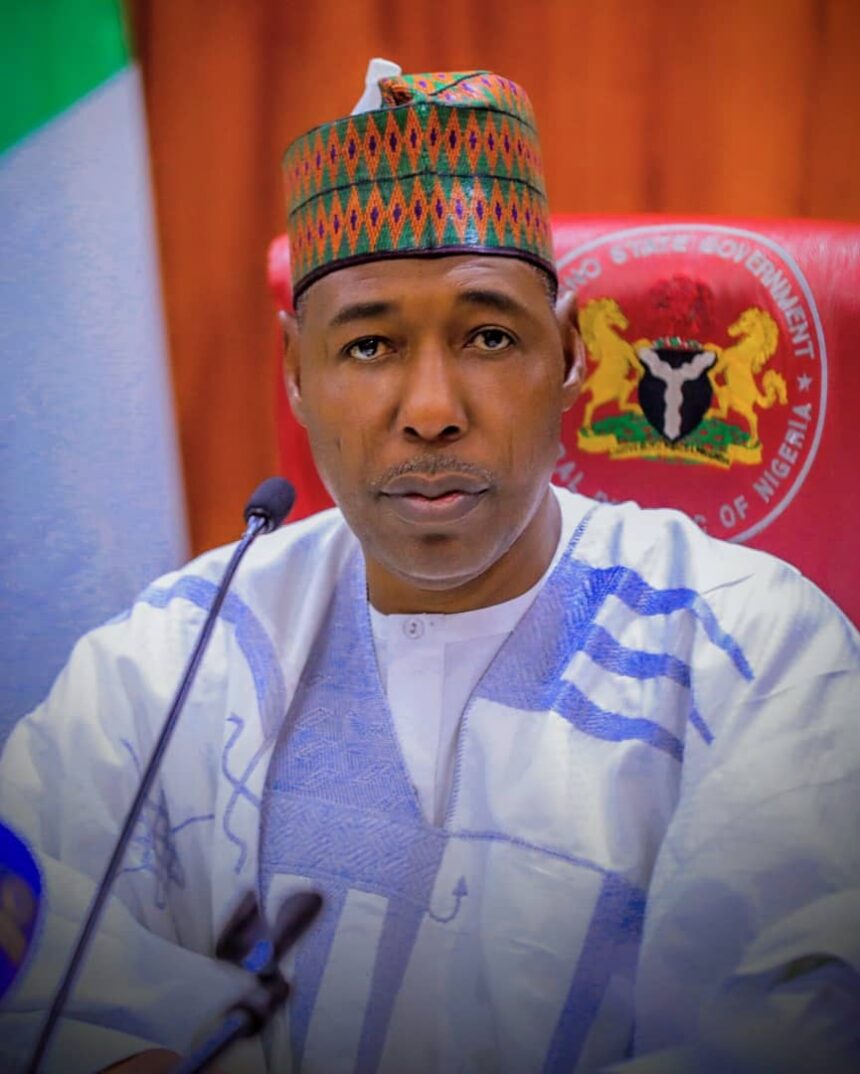
Today, Governor Babagana Umara Zulum turns 56. His birthday comes at a time when his leadership is once again under intense scrutiny. In the past few days, criticisms have been directed at him, particularly concerning the reintegration of repentant combatants in Borno State. Yet, it is in moments like these that we must rise above surface-level reactions and examine with clarity, depth, and independence the substance of his leadership, the intentions behind his policies, and the promise of the Borno Model.
FEW LEADERS in contemporary Nigeria bear the weight of responsibility that Governor Zulum carries. Governing Borno is not just about politics; it is about standing at the epicenter of one of Africa’s most devastating humanitarian and security crises. In this landscape of displacement, destruction, and despair, Zulum has consistently displayed courage, accessibility, and sincerity of purpose.
What distinguishes him is not perfection—no leader is immune from shortcomings—but his unwavering commitment to the people of Borno. He has dared to innovate, to try what others would not, and to pioneer governance strategies that blend the imperatives of security, development, and humanitarian response.
THE HALLMARK of Governor Zulum’s leadership is his embrace of non-kinetic approaches to conflict resolution. This is not merely an administrative choice—it is a recognition of the limits of force in ending cycles of armed violence. Military operations may degrade insurgent capacity, but it is governance, reconciliation, education, livelihoods, and community resilience that ultimately sustain peace.
This framework, now widely referred to as the BORNO MODEL, holds great promise. It integrates humanitarian action with long-term development strategies and recognizes that the human and social dimensions of conflict cannot be ignored. For scholars of disaster management and humanitarian studies, this approach resonates with tested global peacebuilding frameworks where communities move from emergency to recovery through deliberate investments in human dignity, reintegration, and socio-economic empowerment.
ONE OF THE LOUDEST criticisms against Governor Zulum concerns the reintegration of repentant combatants. Many forget that a significant number of these individuals were initially forcefully conscripted by insurgents. Their reintegration is not an indulgence but a strategic necessity. Without it, the cycle of violence is destined to continue.
In my professional journey, I have had the privilege of engaging with over 1,000 repentant combatants at both the Bulumkutu Interim Care Centre (BICC) and the Hajj Camp in Maiduguri, where I led centre-based rehabilitation initiatives. From these direct encounters, it became clear that the real challenge is not the rehabilitation process itself—which has recorded considerable progress—but the community reintegration phase.
This phase is hampered by systemic deficiencies: inadequate financing, limited livelihood opportunities, weak community support structures, and persistent stigma. These are not failures of Governor Zulum’s leadership; they are the outcomes of broader structural and financing gaps that require the intervention of both the Federal Government and the international community.
WHY ZULUM MUST BE SUPPORTED, NOT CASTIGATED:
It is both unfair and counterproductive to castigate Governor Zulum for structural problems beyond the scope of his state’s limited resources. What Borno needs at this critical juncture is not blame but solidarity. Supporting Zulum is synonymous with supporting Nigeria’s fight against insurgency and armed violence. His model, though imperfect, is the most coherent pathway to peace we have seen in the last decade.
Critics must also recognize that Governor Zulum has not shied away from confronting insurgency through military collaboration when necessary. His approach is a hybrid—securing lives with force when unavoidable, but investing in non-kinetic solutions for lasting stability. That balance is what Nigeria needs in the broader fight against insecurity.
AS WE REFLECT on Governor Zulum’s 56th birthday, I call on the Federal Government and the international community to be far more intentional in supporting Borno State. Funding for reintegration, community resilience, psychosocial support, and livelihood interventions must be sustained. The global community cannot treat Borno as a footnote in the global security discourse—it is a frontline in the war against extremism, one whose lessons will shape peacebuilding strategies across the Sahel and beyond.
The Borno Model must be seen not as an experiment of one man but as a beacon of what is possible when courage meets innovation. Governor Zulum has done his part by demonstrating vision and political will. Now, it is up to Nigeria and the international community to rally behind him.
CONCLUSIVELY, On his 56th birthday, I join millions to celebrate Governor Babagana Umara Zulum—not just for who he is, but for what he represents. He is a reminder that even in the harshest conditions, leadership can be courageous, innovative, and people-centered.
History will not judge him by the noise of today’s criticisms but by the long-term impact of his vision for a peaceful and restored Borno. It is our collective responsibility to ensure that vision is not left to falter.
Happy 56th Birthday, Governor Zulum. May the promise of the Borno Model be fulfilled in our lifetime.
Professor Christopher Chinedumuije,
Professor of Disaster Management and Humanitarian
GOVERNOR BABAGANA UMARA ZULUM AT 56: THE BORNO MODEL



Leave a Comment
Leave a Comment